
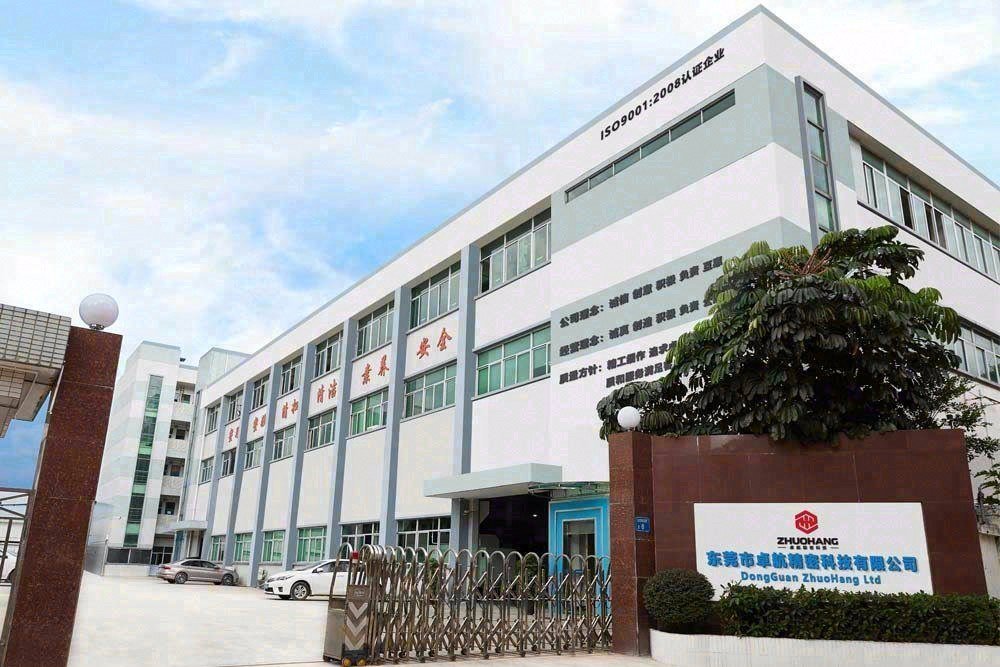
- Dongguan Zhuohang Ltd — founded 2005, registration 91441900MA4UWT6X39.
- 6,800 m² facility, 100+ employees, 80%+ skilled technicians.
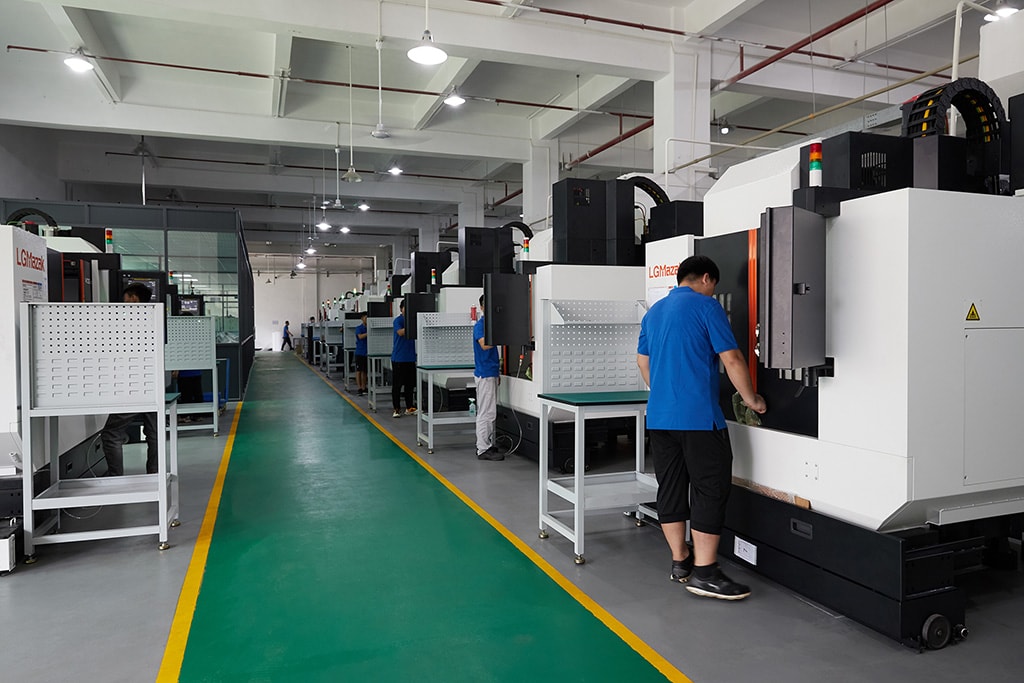
- 100+ production machines across milling, turning, mill-turn, and grinding.
- ISO 9001 + IATF 16949 + ISO 14001 certified.
The short answer: the factory is the reason the price and the lead time are what they are. A manufacturer with 50+ 3-axis centers spreads the machine rate over volume in a way a small shop cannot; a manufacturer with turning, mill-turn, and grinding in the same building removes the handoffs that inflate lead time and cost. That is the whole TCO story, made physical.
Who owns and runs the factory?
The legal entity is Dongguan Zhuohang Ltd, also known as Zhuohang Precision Machining Factory, founded in 2005 and headquartered in Hengli Town, Dongguan City, Guangdong Province, China. The business registration number is 91441900MA4UWT6X39, which you can verify through the Chinese business registry. Marketing under the 3 Axis CNC Milling name does not change the legal identity behind the work.
How large is the facility and what does it hold?
The facility covers 6,800 m² and houses 100+ employees, of whom 80%+ are skilled technicians. On the production side there are 100+ machines: 50+ 3-axis, 20+ 4-axis, and 20+ 5-axis machining centers, 25+ CNC lathes, and 7+ grinders. On the inspection side there are 20+ instruments, including Hexagon GLOBAL S CMMs, vision measuring machines, an XRF spectrometer, and a laser microscope.
Why does an in-house factory lower total cost?
Every time a part leaves the building for a secondary operation, three things happen: lead time stretches, freight is added, and accountability splits. Keeping milling, turning, mill-turn, and grinding under one roof removes most of those handoffs. Scale does the rest — a shop running 50+ 3-axis centers on flat and boxy parts has a lower machine rate than a boutique shop, and that saving passes straight through to the part price. This is the mechanical reason the same drawing often quotes lower from a large in-house manufacturer than from a trading desk.
Which machine families run on the floor?

Naming the equipment is how a manufacturer proves it is one, because a trading company recycles brochures instead. The floor runs high-speed Brother SPEEDIO verticals, Mazak VCE verticals for heavier cutting, Mazak VARIAXIS 5-axis and INTEGREX mill-turn centers, Mazak QT-COMPACT dual-spindle turning, and Citizen Cincom, Star SR, and Tsugami B-series Swiss-type lathes for slender precision shafts.
| Role | Machine family | Buyer note |
|---|---|---|
| High-speed verticals | Brother SPEEDIO | Fast, rigid 3-axis work for flat parts |
| Heavy verticals | Mazak VCE | Larger workpieces and harder materials |
| 5-axis / mill-turn | Mazak VARIAXIS · INTEGREX | Complex, multi-face geometry in one setup |
| Dual-spindle turning | Mazak QT-COMPACT | Done-in-one round parts |
| Swiss-type lathes | Citizen Cincom · Star SR · Tsugami B | Slender, precision shafts |
Which certifications does the factory hold?
Three certificates, each with a number you can verify with the registrar, back the quality and environmental systems. The IATF 16949 scope is stated honestly — it excludes product design under Clause 8.3 — because this is a build-to-print operation.
| Standard | Certificate number | Scope |
|---|---|---|
| ISO 9001:2015 | 116024/A/0001/UK/En | Machining of metal parts |
| IATF 16949:2016 | 131941/A/0001/SM/En | Manufacture of CNC metal machining parts (excludes product design, Clause 8.3) |
| ISO 14001:2015 | 116024/B/0001/UK/En | Environmental management related to machining of metal parts |
What does the factory do about sustainability and IP?
Cost is not the only thing you should check. The factory operates rooftop solar generating roughly 20,000 kWh of green power a month, holds an ISO 14001 environmental system, and enforces a code of conduct covering anti-forced-labor, anti-child-labor, labor contracts, and social insurance for all employees. On intellectual property, sensitive paper documents are stored in a smart-lock space and electronic data on encrypted drives, so a customer's drawings stay confidential.
What should you verify when auditing the factory?
- The machine list, not a stock photo. A manufacturer names models and counts; a trading company recycles brochures.
- The registration number. 91441900MA4UWT6X39 should resolve to Dongguan Zhuohang Ltd in the registry.
- The certificate numbers. ISO and IATF certificates are checkable with the registrar.
- Who owns the secondary steps. Anodizing, plating, and titanium stress relief may be outsourced — a manufacturer says so and names the partner.
- The floor itself. A visit shows whether the scale and equipment match the brochure.
Factory visits are welcomed. Seeing the production floor, the inspection area, and the quality system in person is the fastest way to confirm the claims on this page. Contact [email protected] to schedule one.
How does the Dongguan location help total cost?
Location is a quiet contributor to total cost, because it sits inside the supply chain that feeds the shop floor. Dongguan sits in the Pearl River Delta manufacturing region, where raw bar and billet, cutting tools, and secondary processes such as anodizing and heat treatment are dense and close. That density shortens the inbound supply of material and tools, and it keeps secondary steps from adding days of freight.
The same region gives access to the port infrastructure of the Pearl River Delta, which shortens the outbound leg to the buyer in Europe, North America, and Japan. A factory that is close to its material, its tools, and its port is a factory where fewer of those costs and days leak into your part price and lead time. None of this appears on the invoice as a line item — it appears as a lower machine rate and a shorter lead time.
- Material proximity — bar, billet, and plate suppliers are nearby, cutting inbound freight and lead time.
- Tooling proximity — standard end mills and drills are restocked quickly, keeping jobs running.
- Secondary-process proximity — anodizing, plating, and heat treatment partners are close, reducing handoff days.
- Port access — the Pearl River Delta shortens the outbound leg to export markets.
How is the production floor organized?
The floor is laid out around the flow of a part, not around the type of machine. Material comes in at receiving, is checked, and then moves through the sequence of operations the part needs — milling, turning, mill-turn, or grinding — before inspection and finishing. Because the whole metal-cutting range is under one roof, most parts never leave the building between operations, which is what keeps lead time short and accountability single.
The organization matters because it removes queue time. A part that needs a milled pocket and then a turned boss does not wait for a truck to an outside lathe shop; it moves to the turning cell in the same building. The inspection bench sits on the same floor, so a part that needs a first-article check is measured and released without leaving the facility. Flow is the physical version of the total-cost argument.
| Area | What it does | Why it matters to cost |
|---|---|---|
| Receiving / material | XRF check of incoming stock against mill cert | Catches bad material before it is machined |
| Milling cells | 3/4/5-axis machining centers | Prismatic parts on the lowest-cost route |
| Turning / mill-turn | Lathes and multi-task centers | Round parts without an outside handoff |
| Grinding | Surface, centerless, cylindrical | ±0.002 mm finishes in-house |
| Inspection | CMMs, vision, XRF, surface testers | Verification without leaving the floor |
What does the machine mix mean for routing?
The machine mix is a routing resource, not a marketing list. The factory holds 50+ 3-axis centers, 20+ 4-axis, 20+ 5-axis, 25+ lathes, and 7+ grinders. That ratio — heavily weighted toward 3-axis — mirrors what buyers actually order: most parts are prismatic and belong on the cheapest process. The capacity is there for the geometry, and the geometry decides the routing.
For you, the mix means a part is not forced onto whatever machine happens to be free. A flat bracket routes to the 3-axis cell where it is cheapest; an angled part routes to a 4th axis instead of paying for a custom fixture; a five-face part routes to 5-axis instead of accumulating re-clamp error. A shop with the full range can route by geometry, and routing by geometry is what keeps the total cost down.
- 50+ 3-axis centers — the workhorse for flat and boxy parts, lowest rate.
- 20+ 4-axis centers — angled holes and wrapped faces without custom fixtures.
- 20+ 5-axis centers — complex curved and multi-face geometry in one setup.
- 25+ lathes — shafts, pins, and round parts in a single clamping.
- 7+ grinders — bearing seats and roundness-critical surfaces to ±0.002 mm.
How does the factory hold tolerances repeatably?
Holding ±0.003 mm (milling) / ±0.002 mm (turning) once is a matter of a good machine and a careful setup. Holding it repeatably, across batches and re-orders, is a matter of the system around the machine. That system has three parts: rigid, well-maintained machines; calibrated metrology; and statistical process control that watches the process instead of just the parts.
On the machine side, the floor runs rigid verticals and turning centers from Mazak, Brother, TSUGAMI, Sodick, and Citizen/Star families, which are chosen as much for their repeatability as their speed. On the metrology side, Hexagon GLOBAL S CMMs and vision machines measure the output and feed it back. On the process side, SPC charts track key characteristics with Ppk ≥ 1.67 initial, so drift is caught in the run, not after the batch. The three together are what make the tolerance a guarantee rather than a target.
How does the factory scale from prototype to production?
The path from one prototype to a production run is where many programs fail, because the prototype was made on different machines than the production will run on. This factory's answer is that there is no separate prototype line — a single-part MOQ 1 order runs on the same machines, with the same tolerances, and the same inspection as the production run that follows. What you validate is what you receive at scale.
That continuity matters for two reasons. First, the process is the same, so the first-article you approved is a fair prediction of the thousandth part. Second, the setup, tooling, and program are retained from the prototype, so the production run does not pay the setup cost twice and the lead time does not restart from zero. A program that validates on the production equipment is a program that scales without surprises.
What happens on a factory visit?
A factory visit is the fastest way to turn a brochure into evidence, and visits are welcomed and encouraged here as part of due diligence. The visit follows the flow of the part: receiving and material inspection, the milling and turning cells, the grinding area, the inspection bench, and the finishing handoff. Along the way you can see the machine list match the floor, the calibration labels on the metrology, and the lot segregation on the material shelves.
The questions to bring are the ones that are hard to answer with a stock photo: ask to see the machine models you were quoted, ask to see a control plan or an SPC chart from a current job, and ask who owns the secondary steps. A factory that welcomes those questions is one that is confident in its answers. Contact [email protected] to schedule a tour.
What this shop actually runs
If you ask for capability evidence, you deserve a specific answer. This facility operates 100+ CNC machines across 6,800 m2 in Dongguan, China, staffed by 100+ people. The machines, listed by category:
- 5-axis machining centres (10+) - Mazak VARIAXIS I-600 (510/910/510 mm travel, 12,000 rpm, 22 kW, 71.6 N·m, 30-tool BT40) and Mazak INTEGREX I-250H S (B-axis 0.0001°, 24 kW, 124 N·m, 38-tool HSK-A63). Set up for compound-angle parts, single-setup multi-face prismatic work, and aerospace fittings where datum transfer loss is unacceptable.
- 3-axis / 4-axis machining centres (50+) - Brother SPEEDIO S500Z2N / S700Z2N (10,000 rpm, 14/21-tool ATC, 0.7 s tool-to-tool, Z-axis 2.2 G) and Mazak VCE-430A L / VCE-570C L (10,000 rpm, 118 N·m, 24-tool ATC). Set up for prismatic parts, plates, brackets, housings.
- Swiss-type turning centres (10+) - Citizen Cincom A20-3F7 (Φ20 mm, 10,000 rpm), TSUGAMI B0206-III / B0205-III (Φ20 mm, 0.1 µm), STAR SR-32JII / SR-32J Type N (Φ32 mm, 8,000 rpm). Set up for long, slender rotational parts at ±0.002 mm.
- CNC turning centres (20+) - HEADMAN T70M/1250 (720 mm swing, 117 mm bore, 3,000 rpm, BMT75 12-station turret). Set up for shafts, bushings, flanges up to ±0.002 mm.
- Wire EDM (5+) - Sodick AQ535L (550/350/300 mm travel, ±20° taper, 800 kg workpiece). Set up for hardened tool steel, internal splines, sharp internal corners that milling cannot reach.
- Inspection: Hexagon CMM + 20+ gauges - Hexagon CMM for coordinate measurement, plus vision system, profilometer, hardness tester, coating thickness gauge, XRF for material verification. The 10:1 rule (gauge 10x more accurate than the band) is applied to every feature.
- Machine highlights - VARIAXIS I-600: one-setup multi-face 5-axis + MAZA-CHECK auto-calibration; INTEGREX I-250H S: DONE-IN-ONE mill-turn, B-axis 0.0001° + Ai thermal shield; SPEEDIO S500Z2N / S700Z2N: Z-axis 2.2 G + 0.7 s ATC; Swiss-type: guide-bush switchable + 0.1 µm resolution.
Tolerance bands: ±0.003 mm milled, ±0.002 mm turned, ±0.002 mm ground or wire-cut. Capability indices: Ppk >= 1.67 at the initial study; Cpk >= 1.33 ongoing in production.
Certifications: ISO 9001:2015 (116024/A/0001/UK/En) · IATF 16949:2016 (131941/A/0001/SM/En, design clause 8.3 excluded) · ISO 14001:2015 (116024/B/0001/UK/En), held by Dongguan Zhuohang Ltd (USCC 91441900MA4UWT6X39, since 2005).
Service area: we supply Austria, Belgium, the Czech Republic, Denmark, France, Germany, Greece, Hungary, Ireland, Italy, the Netherlands, Spain, Sweden and the United Kingdom in Europe; Brazil, Canada, Mexico and the United States in the Americas; China, Israel, Japan, Singapore and Sri Lanka in Asia; Australia and New Zealand in Oceania; and South Africa in Africa, with worldwide delivery from China.
Contact: Felipe Iglesias, [email protected], +86 13126536955.
Verify the factory for yourself — schedule a visit.
Email [email protected] or call +86 13126536955.
Frequently Asked Questions
Who owns and runs the factory?
In short, Dongguan Zhuohang Ltd, also known as Zhuohang Precision Machining Factory and Dongguan Zhuohang Precision Technology Co., Ltd., runs the factory. The company was founded in 2005, and the legal registration number is 91441900MA4UWT6X39, which can be checked through the Chinese business registry.
How large is the facility and how many machines does it hold?
The facility is 6,800 m² with 100+ employees and 100+ production machines — 3-axis (50+), 4-axis (20+), 5-axis (20+), 25+ lathes, and 7+ grinders — plus 20+ inspection instruments including Hexagon CMMs.
Where is the factory located?
No. 8, Shuibian Songyuan Road, Hengli Town, Dongguan, Guangdong, China 523470. GPS coordinates are 23.048947, 113.990605. Factory visits are welcome with advance notice.
Why does an in-house factory lower total cost?
Keeping milling, turning, mill-turn, and grinding under one roof removes supplier handoffs, freight, and their failure points. Scale on common processes like 3-axis lowers the machine rate, and that saving passes through to the part price.
Which certifications does the factory hold?
ISO 9001:2015 (116024/A/0001/UK/En), IATF 16949:2016 (131941/A/0001/SM/En), and ISO 14001:2015 (116024/B/0001/UK/En), each with a certificate number you can verify with the registrar.
Can I visit the factory before ordering?
Yes. Visits are welcomed and encouraged as part of due diligence. Contact [email protected] to schedule a tour of the production floor, inspection area, and quality system.
Continue reading: 4 Axis CNC Milling · 5 Axis CNC Milling
Standards referenced on this page
- ASTM A582/A582M-12 — Standard Specification for Free-Machining Stainless Steel Bars
- ISO 14001 — Environmental management systems — Requirements with guidance for use
- ASTM A484/A484M-24 — Standard Specification for General Requirements for Stainless Steel Bars, Billets, and Forgings